
Training Data forAutonomous Vehicles
Build safer and smarter autonomous driving systems with accurate 2D, 3D, LiDAR, video, lane, and semantic segmentation annotation services.
From object detection to complex road-scene understanding, Annotexia helps transform raw sensor data into structured datasets ready for computer vision and machine learning.
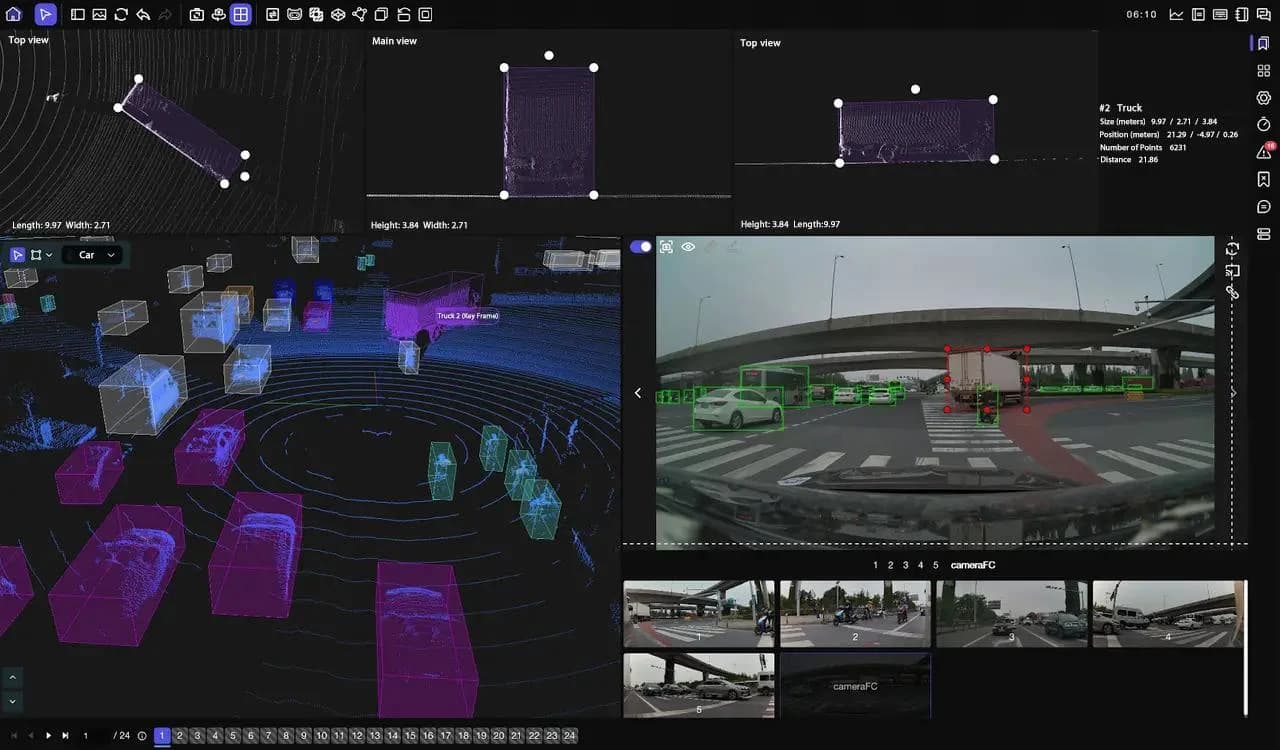
Perception Data
2D + 3D + LiDAR
Quality Focus
Multi-Level QA
Autonomous Driving Starts With Better Data
An autonomous vehicle constantly interprets its surroundings through cameras, LiDAR, radar, and other sensors. Every vehicle, pedestrian, lane, traffic sign, and obstacle must be understood correctly by the perception system.
That understanding depends heavily on the quality of the training data used to develop the model. Accurate annotation helps AI systems learn how to recognize and interpret complex real-world driving environments.
Autonomous Vehicle Annotation Services
Build perception datasets across camera imagery, video, and 3D sensor data with annotation workflows tailored to your AI model requirements.
2D Bounding Box Annotation
Precisely identify vehicles, pedestrians, cyclists, traffic signs, traffic lights, and other road objects in camera imagery.
3D Bounding Box Annotation
Create accurate 3D cuboids around road objects to help perception systems understand object position, size, and orientation.
LiDAR Annotation
Label point-cloud data for autonomous driving perception, object detection, localization, and 3D scene understanding.
Semantic Segmentation
Classify road scenes at pixel or point level including roads, vehicles, buildings, vegetation, sidewalks, and obstacles.
Lane & Road Annotation
Annotate lane boundaries, road markings, drivable areas, intersections, curbs, and other road infrastructure.
Object Tracking
Track vehicles, pedestrians, cyclists, and other dynamic objects consistently across video frames.
Annotate the Objects That Matter
Autonomous driving systems need to understand far more than vehicles. Our annotation workflows can be customized around the objects and environmental classes relevant to your model.
Discuss your annotation requirementsWhere Autonomous Vehicle Data Annotation Fits
High-quality labeled data supports perception, mapping, safety, testing, and intelligent mobility applications.
Autonomous Driving
Build perception datasets that help autonomous vehicles detect, classify, localize, and track objects in complex road environments.
ADAS Systems
Support advanced driver assistance systems including collision detection, lane departure warnings, pedestrian detection, and emergency braking.
Vehicle Perception
Create high-quality datasets for computer vision and sensor-based perception models operating in real-world environments.
HD Mapping
Annotate road infrastructure, lanes, traffic signs, intersections, and environmental elements used for high-definition mapping.
Robotics & Mobility
Provide perception datasets for autonomous robots, delivery vehicles, warehouse mobility systems, and other intelligent machines.
Simulation & Testing
Prepare labeled datasets for validating perception models across different environments, weather conditions, and traffic scenarios.
From Raw Sensor Data to AI-Ready Dataset
A structured workflow helps maintain consistency across large and complex autonomous vehicle annotation projects.
Project Understanding
We review your sensor data, annotation requirements, classes, formats, guidelines, and quality expectations.
Annotation Guidelines
Our team converts project requirements into clear annotation instructions and edge-case rules.
Pilot Annotation
A representative sample is annotated first to validate the guidelines, workflow, and expected quality.
Production Annotation
Trained annotators process the approved dataset using the required annotation platform and workflow.
Quality Assurance
Annotations are reviewed using structured QA processes to identify missing, incorrect, or inconsistent labels.
Dataset Delivery
Validated annotations are delivered in your required format and organized for downstream AI model development.
Quality-First Annotation
Autonomous vehicle datasets often contain difficult edge cases. Our quality workflow focuses on annotation consistency, missing objects, incorrect classifications, tracking errors, and adherence to project-specific guidelines.
- Detailed annotation guidelines
- Annotator training
- Sample validation
- Multi-level quality review
- Edge-case handling
- Continuous feedback
Secure Data Handling
Vehicle and sensor datasets can contain sensitive operational information. We support confidential workflows designed around your project's security and access requirements.
- NDA-supported projects
- Controlled project access
- Confidential annotation workflows
- Secure data transfer practices
- Project-specific permissions
- Controlled dataset delivery
Flexible Annotation Formats
We can work with your existing annotation environment and deliver validated datasets according to your downstream machine learning pipeline.
Building the Next Generation of Autonomous Mobility?
Tell us about your sensor data, annotation requirements, project volume, and timeline. We'll help you plan the right annotation workflow.
Autonomous Vehicle Annotation FAQs
Answers to common questions about our autonomous vehicle and ADAS data annotation services.
What types of autonomous vehicle data can Annotexia annotate?+
We support camera images, video, LiDAR point clouds, and other perception datasets. Depending on the project, we can annotate vehicles, pedestrians, cyclists, traffic signs, traffic lights, lanes, road surfaces, obstacles, and other environmental objects.
Do you provide LiDAR and 3D annotation?+
Yes. Our autonomous vehicle annotation services include LiDAR point-cloud labeling, 3D bounding boxes, cuboids, object classification, and other 3D perception annotation workflows.
Can you annotate video for object tracking?+
Yes. We can track objects across video sequences, including vehicles, pedestrians, cyclists, and other relevant road objects. Tracking rules can be customized according to your model requirements.
Can you follow our existing annotation guidelines?+
Yes. We can work with your existing annotation guidelines and adapt our production workflow to your class definitions, edge cases, quality requirements, and preferred annotation platform.
Which annotation formats do you support?+
We support commonly used formats such as COCO, YOLO, Pascal VOC, JSON, XML, CSV, and custom formats. LiDAR and 3D projects can also be delivered according to the required project-specific structure.
Can Annotexia handle large autonomous driving datasets?+
Yes. Our workflows are designed to support projects ranging from small pilot datasets to large-scale annotation programs. Production capacity can be planned according to your volume, timeline, and quality requirements.
Can I test your annotation quality before starting a large project?+
Yes. We can provide a sample annotation so you can evaluate our labeling quality, interpretation of your guidelines, communication process, and expected turnaround before moving into larger production volumes.
Explore More AI Data Annotation Solutions
Autonomous Vehicle Data Annotation Services
Annotexia provides autonomous vehicle data annotation services for companies developing autonomous driving, advanced driver assistance systems, vehicle perception, robotics, and intelligent mobility solutions. Our annotation capabilities cover camera imagery, video, LiDAR point clouds, 2D and 3D bounding boxes, semantic segmentation, lane detection, object tracking, and other perception tasks.
Accurate training data is essential for developing computer vision systems that operate in complex road environments. Our annotation workflows can be customized around your object classes, labeling guidelines, edge cases, annotation platform, quality requirements, and delivery format.
Whether you are developing an autonomous vehicle perception model, ADAS application, HD mapping system, or robotics platform, Annotexia can help transform raw sensor data into structured training datasets designed for machine learning development.
Contact Annotexia to discuss your autonomous vehicle annotation requirements, request a sample annotation, and plan a scalable data labeling workflow for your AI project.